Long-term care insurance policy and benefits summary sheet (template)
Struggling to keep track of what your parent’s long-term care insurance policy actually covers? This template helps you pull the key terms – benefit triggers, home-care coverage, elimination period, and caps – into a single, plain-language page you can use for calls, care planning, and documentation.
Get the free printable LTCI policy summary ↓No account required.By Rachel Moore, Founder, Sagebeam · Published June 2026 · How we research and review our guides
Most long-term care insurance (LTCI) policies are dozens of pages long. You might read the whole thing once, but when you are in the middle of:
- Deciding whether to start home care,
- Calling the insurer to ask about benefit triggers, or
- Filling out claim paperwork,
it is not realistic to re-read every clause.
This article gives you a long term care insurance policy summary template you can use to pull the most important details into a single, plain-language page – so you and your siblings have the same quick reference point for coverage and benefit decisions.
It is educational and is not legal or financial advice. Always rely on your parent’s actual policy documents and written guidance from the insurer when making decisions about coverage or claims.
If you have not read the policy closely yet, start with:
- How to read your parent’s long-term care insurance policy in plain language
- What documentation you need before filing a long-term care insurance home-care claim
- How to avoid adding months to the long-term care insurance elimination period
- Long-term care insurance prep and call notes worksheet (template)
- What to track during a parent’s hospital stay
- How to help a parent transition home after a hospital stay – especially if you reached for the policy because of a recent hospitalization or rehab stay.
On this page:
- Quick answer – what your LTCI policy summary sheet should include
- How this summary sheet fits with your other LTCI tools
- Long-term care insurance policy and benefits summary sheet template (copy and adapt)
- Step-by-step: filling out your one-page summary
- When to update your summary – and when to go back to the full policy
Jump to template: LTCI policy and benefits summary sheet
Quick answer: what your LTCI policy summary sheet should include
Your LTCI policy and benefits summary sheet should fit on one page and answer, in plain language:
-
Who and what this policy covers
- Policyholder name and policy number.
- Insurer name and key contact numbers.
- Whether the policy covers home care, facilities, or both.
-
When benefits start
- The benefit triggers – for example, “needs help with at least 2 of 6 ADLs for 90+ days” or “severe cognitive impairment” and how the policy defines them.
- Any notes on physician certifications or assessments required.
-
How much the policy will pay, and for how long
- Daily or monthly benefit amount.
- Benefit period (years) or total benefit pool (dollar amount).
- Any differences between home-care and facility benefit amounts.
-
Elimination period details
- Length of the elimination period in days.
- Whether days must be consecutive or cumulative.
- What counts as an elimination-period day for home-care days.
-
Home-care coverage specifics
- Whether home care is covered and, if so, at what percentage of the facility benefit.
- Rules about which providers qualify (licensed agencies, independent caregivers, any network requirements).
- Any notes about family caregivers (usually not paid directly).
-
Key limitations, exclusions, and gotchas
- Conditions or settings that are excluded.
- Any waiting periods for pre-existing conditions.
- Notes about geographic limits or other important restrictions.
-
Open questions and clarifications from the insurer
- A short list of questions you still need to ask.
- Any clarifications you have already received on calls, in your own words.
For background on how long-term care benefits and Medicaid coordination generally work, the Administration for Community Living's long-term care planning hub is a useful federal reference point alongside your parent's actual policy.
The template below pulls these ideas into a reusable one-page format.
How this summary sheet fits with your other LTCI tools
Think of the LTCI policy and benefits summary sheet as the “front cover” of your LTCI documentation system:
- The full policy is the official contract.
- Your summary sheet is the quick reference everyone actually uses.
- Your call notes worksheet records what the insurer says when you ask questions about specific clauses.
- Your elimination-period tracker and care logs show how your parent’s real life is lining up with the policy’s rules.
Once your summary is in hand, these guides are the natural next steps:
- How to activate a long-term care insurance policy for home care – the intake call, claim forms, and covered settings.
- Questions to ask your LTCI company before starting home care – use your summary to answer the questions they will ask you.
- How LTCI, Medicaid, and private pay fit together for home care – if your parent has, or may eventually qualify for, Medicaid alongside LTCI.
You might:
- Print the summary sheet and keep it inside the front cover of the policy binder.
- Store it in a shared digital folder or workspace like Sagebeam, with links to call notes and trackers.
- Bring it to medical or financial-planning appointments so professionals can see the structure of the policy at a glance.
The goal is for everyone – you, siblings, care managers, and advisors – to work from the same shared snapshot of what the policy does and does not do.
Long-term care insurance policy and benefits summary sheet template (copy and adapt)
You can copy and paste this long term care insurance benefits summary sheet into your own document, spreadsheet, or caregiving workspace, or print it and fill it out by hand. Adjust labels and sections so they match your parent’s specific policy.
LONG-TERM CARE INSURANCE (LTCI) POLICY & BENEFITS SUMMARY – ONE PAGE

Parent / policyholder name: __________________________________________
Policy number: ______________________________________________________

Insurer name: _______________________________________________________
Insurer phone number(s): ____________________________________________
Claim mailing address / fax / portal: ________________________________

POLICY SNAPSHOT

Policy issue date: ______________________

Does this policy cover (check all that apply)?
- [ ] Home care / home health care
- [ ] Assisted living facility
- [ ] Nursing facility
- [ ] Adult day care / other: ________________________

BENEFIT AMOUNTS & PERIOD

Daily or monthly benefit amount:
_____________________________________________________________________

Benefit period (years) OR total benefit pool:
_____________________________________________________________________

Any differences in benefit amount between home care and facility care:
_____________________________________________________________________
_____________________________________________________________________

BENEFIT TRIGGERS (WHEN BENEFITS START)

In plain language, when does this policy say benefits are payable?
(for example: “Needs help with at least 2 of 6 ADLs for 90+ days”)
_____________________________________________________________________
_____________________________________________________________________

Activities of Daily Living (ADLs) listed in the policy:
_____________________________________________________________________

Does cognitive impairment also trigger benefits? If yes, how is it defined?
_____________________________________________________________________
_____________________________________________________________________

Any notes about physician certifications or assessments required:
_____________________________________________________________________
_____________________________________________________________________

ELIMINATION PERIOD

Elimination period length (in days): _________________________________

Are days (circle one): CONSECUTIVE / CUMULATIVE / UNSURE

What counts as an elimination-period day for HOME CARE?
_____________________________________________________________________
_____________________________________________________________________

HOME-CARE COVERAGE DETAILS

Is home care covered by this policy? YES / NO / UNSURE

If yes, at what level compared to facility care?
_____________________________________________________________________

Which providers qualify for home care under this policy?
(for example: licensed agencies only, independent caregivers allowed)
_____________________________________________________________________
_____________________________________________________________________

Are family caregivers paid directly by the policy? YES / NO / UNSURE
Notes:
_____________________________________________________________________

KEY LIMITATIONS, EXCLUSIONS, AND NOTES

Important exclusions or limitations to remember:
(conditions, settings, geographic limits, pre-existing conditions)
_____________________________________________________________________
_____________________________________________________________________
_____________________________________________________________________

COORDINATION WITH OTHER COVERAGE (IF MENTIONED)

Any notes about how this policy interacts with Medicaid, Medicare,
or other insurance:
(for example: “policy says LTCI benefits may be coordinated with Medicaid”
or “no mention anywhere in the contract”)
_____________________________________________________________________
_____________________________________________________________________

OPEN QUESTIONS & CLARIFICATIONS FROM INSURER

Questions we still need to ask:
- _________________________________________________________________
- _________________________________________________________________

Key clarifications we have already received (our words):
- Date: __________  Representative: ______________________________
  Notes: ________________________________________________________
- Date: __________  Representative: ______________________________
  Notes: ________________________________________________________
You can also adapt this into a two-column table or a simple dashboard-style page if that fits your style better.
Step-by-step: filling out your one-page summary
To get the most out of this template:
-
Read the policy with the template beside you
- Use the policy-reading guide to find the relevant sections.
- As you find answers, write them in plain language on the summary sheet.
-
Start with the easy parts
- Fill in policyholder information, insurer contacts, benefit amounts, and benefit period first.
- Then tackle elimination period and settings (home care vs facilities).
-
Translate benefit triggers and definitions into your own words
- Read the formal definitions of ADLs and cognitive impairment.
- Write a one- or two-sentence explanation of when benefits start, using examples that make sense to your family.
-
Capture only the most important exclusions and notes
- You do not need every minor exclusion on this page.
- Focus on issues that are likely to matter for your parent – for example, family caregivers not being paid, or care outside the U.S. not covered.
-
Add questions as you go
- If a clause is confusing, write your question in the “Open questions” section.
- Use your call notes worksheet later to record what the insurer says and then update the summary sheet.
After an initial pass, you should have a workable one-page view of the policy that you can refine over time.
When to update your summary – and when to go back to the full policy
Your LTCI policy and benefits summary sheet is a living document. Update it when:
- You get new information from the insurer (for example, in a call or letter).
- Your understanding of benefit triggers, elimination-period rules, or exclusions changes.
- You are preparing for a major decision, such as activating benefits or coordinating with Medicaid.
You should always go back to the full policy when:
- You are making a significant financial or care decision based on coverage.
- A question involves a specific edge case or exception.
- A professional (lawyer, planner, care manager) asks to see the original contract language.
Used together – full policy, one-page summary, call notes, and documentation – you get the best of both worlds: accuracy and usability. Your summary sheet keeps everyone on the same page day to day, while the policy and your advisors handle the fine print.
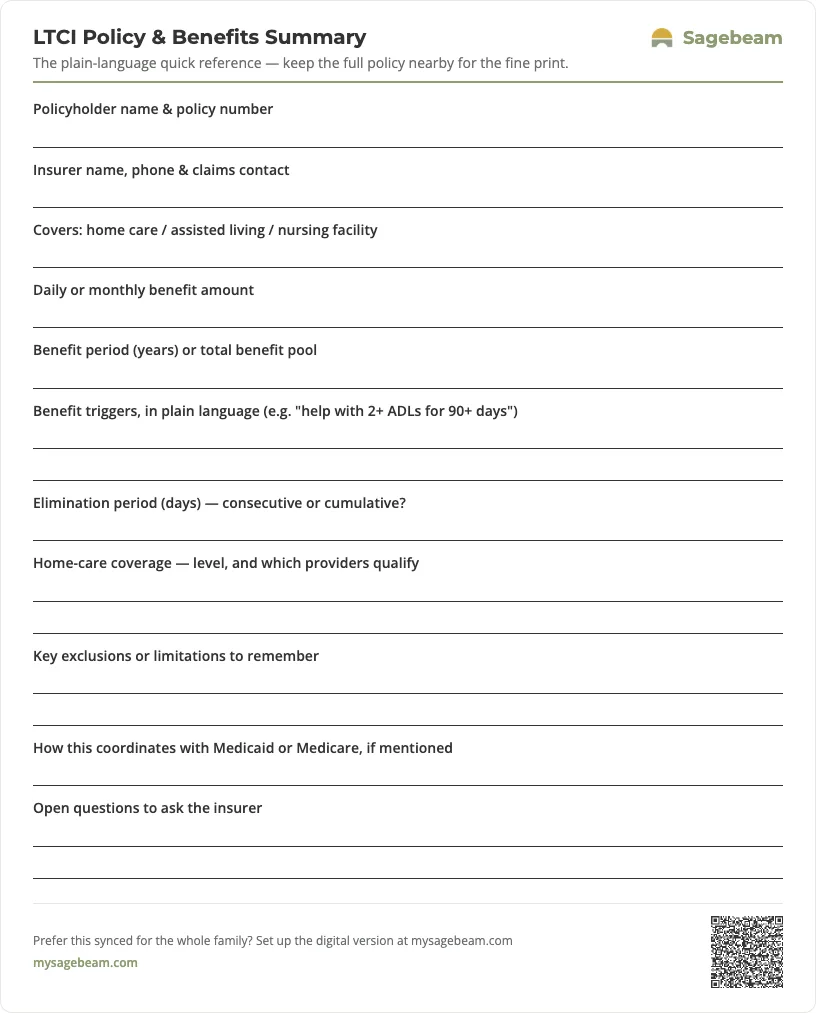
Print your LTCI policy summary
A ready-to-use one-page summary sheet. Print it and keep it in the policy binder, or keep it synced so siblings and advisors see the same snapshot.
 Sagebeam
- How LTCI, Medicaid, and private pay fit together for home care
- How to read your parent’s long-term care insurance policy in plain language
- What documentation you need before filing a long-term care insurance home-care claim
- Does my parent have long-term care insurance? Quick checklist
You don't need more tabs. You need one place to run your parent's care.
By signing up, you agree to the Terms and Privacy Policy.