Doctor visit summary template for family caregivers
Doctor visit summary template for family caregivers to record what the clinician said, medication changes, tests, referrals, and clear next steps in one place.
Get the free printable doctor visit summary ↓No account required.By Rachel Moore, Founder, Sagebeam · Published June 2026 · How we research and review our guides
Part of: Health & safety monitoring – aging parents routine
Many families walk out of appointments with an aging parent feeling like they have more questions than answers. You may remember a few key phrases – “follow up in six months,” “watch for falls,” “let us know if this gets worse” – but not exactly what the doctor said, why they recommended it, or what needs to happen next. That makes it hard to explain decisions to siblings, keep track of changes over time, or see whether doctors are responding to the day‑to‑day changes you are seeing at home. This is especially true for post‑hospital follow‑up visits, where the team is trying to see whether recovery is on track and whether the hospital‑to‑home plan is working.
This guide gives you a doctor visit summary template — a simple caregiver form for the during- and after-visit work — so every appointment ends with one clear page that says what was decided and what happens next. MedlinePlus recommends planning ahead, bringing a complete medication list, prioritizing concerns, taking notes, and reviewing instructions after the appointment in its guide to taking a loved one to the doctor.
Use it to:
- Arrive prepared with questions and recent examples.
- Capture what was decided while it is still fresh.
- Leave with one clear page you can share with family or other caregivers.
It is educational and is not medical or legal advice. Always follow the instructions you receive from your parent’s clinicians or clinic handouts; this template is simply a structured way to record them.
Related resources:
- Doctor appointment checklist after a hospital stay — gather records, home observations, and priority questions before the visit.
- Caregiver medication list template for families — bring a current list and record recent changes.
- Caregiver daily log template for families — pull concrete examples from the days before the visit.
- Emergency medical information sheet template — keep the fast medical snapshot current.
Your before, during, and after doctor-visit kit
- Before: Use the doctor appointment checklist to gather records, recent changes, and the questions you most need answered.
- During: Use this doctor visit summary form to capture the clinician's words, not your memory of them later.
- After: Compare the clinic's official after-visit summary with your notes, assign the follow-ups, and share the family version.
In Sagebeam, this summary lives in the shared care space, so the whole family sees the same record of what changed, what was decided, and who owns each next step.
On this page:
- Quick answer – what a doctor visit summary should include
- Doctor visit summary template (copy and adapt)
- Step‑by‑step: using the template before, during, and after visits
- Tips for sharing visit summaries with siblings and clinicians
Jump to template: Doctor visit summary form
Quick answer: what a doctor visit summary should include
A simple doctor visit summary template for aging parents – essentially a clinic visit summary form for caregivers – usually captures:
-
Basics of the visit
- Date, time, and clinic / provider name.
- Type of visit (new issue, follow‑up, annual exam, post‑hospital check‑in).
-
Why you went
- The main reason(s) for the visit in your own words – for example, “more short of breath,” “more confused in the evenings,” or “review new medication side effects.”
-
What the clinician noticed or said
- Key findings, observations, or phrases that stood out (such as “likely arthritis,” “blood pressure controlled today,” or “mild cognitive impairment, monitoring for now”).
-
Diagnoses, if any
- Any formal diagnoses named or confirmed at the visit.
-
Medication and treatment changes
- Starts, stops, dose changes, and how/when to take new medications or treatments.
-
Tests, referrals, and paperwork
- Labs, imaging, referrals to other specialists, forms completed, and how/when results will arrive.
-
Concrete follow‑ups
- What needs to happen next, by when, and who is responsible – for example, “schedule PT within 2 weeks,” “call clinic if breathing worsens,” or “follow up in 3 months.”
-
Lingering questions or concerns
- Anything you are still unsure about, to bring up at the next visit or via a portal message.
The template below turns these elements into a visit‑summary form you can print or adapt to your own notebook, spreadsheet, or caregiving workspace.
Doctor visit summary template (copy and adapt)
You can copy and paste this after‑doctor‑visit summary template into a notebook, spreadsheet, shared note, or Sagebeam workspace, and adjust fields as needed. For a spreadsheet, each row could be a separate visit, or you can keep one page per visit in a binder.
DOCTOR VISIT SUMMARY – AGING PARENT

Parent name: ________________________________

Date of visit: ____________________   Time: ____________________

Clinic / provider name: ________________________________________
Type of visit (new issue / follow‑up / annual / post‑hospital / other):
_____________________________________________________________________

WHO ATTENDED

Who was at the appointment? (parent, which family members, interpreter, etc.)
_____________________________________________________________________
_____________________________________________________________________

REASON FOR VISIT – IN OUR WORDS

Main reason(s) for this visit:
_____________________________________________________________________
_____________________________________________________________________

Recent examples or observations we wanted to share:
(for example: more short of breath climbing stairs; three near‑falls this month)
_____________________________________________________________________
_____________________________________________________________________

WHAT THE CLINICIAN NOTICED OR SAID

Key phrases or findings that stood out:
_____________________________________________________________________
_____________________________________________________________________

DIAGNOSES (IF ANY)

Diagnoses named or confirmed today (leave blank if none were discussed):
_____________________________________________________________________
_____________________________________________________________________

MEDICATIONS & TREATMENTS

New medications or treatments started (leave blank if none):
Name / dose / how often / how long:
_____________________________________________________________________
_____________________________________________________________________

Changes to existing medications or treatments (leave blank if none):
_____________________________________________________________________
_____________________________________________________________________

Medications or treatments stopped (and why, if explained; leave blank if none):
_____________________________________________________________________
_____________________________________________________________________

TESTS, REFERRALS, & PAPERWORK

Tests ordered today (labs, imaging, other; leave blank if none):
_____________________________________________________________________
How and when we’ll get results:
_____________________________________________________________________

Referrals (for example, PT, cardiology, neurology; leave blank if none):
_____________________________________________________________________
Contact info or how to schedule:
_____________________________________________________________________

Forms or paperwork completed (for example, disability forms, DMV, LTCI, Medicaid, home care; leave blank if none):
_____________________________________________________________________

FOLLOW‑UPS & “WHAT HAPPENS NEXT”

Next appointment(s) (date/time or timeframe):
_____________________________________________________________________

Specific things we need to do at home:
(for example: track blood pressure, log symptoms, watch for falls)
_____________________________________________________________________
_____________________________________________________________________

When to call the clinic or seek urgent help (use wording from your clinician; for example, “Call if new chest pain, trouble breathing, or more than 2 new falls in a week”):
_____________________________________________________________________
_____________________________________________________________________

LINGERING QUESTIONS OR CONCERNS

Questions we still have (for next visit or portal message):
_____________________________________________________________________
_____________________________________________________________________

NOTES

Anything else we want to remember from this visit:
_____________________________________________________________________
_____________________________________________________________________
You can keep this as a single page in a binder or folder for each appointment, or log key details into a spreadsheet or caregiving app if that fits better with your system. If this full layout feels like too much, start by capturing just four things after each visit: date & clinic, reason for visit, changes to medications or treatments, and follow‑ups / when to call.
Step‑by‑step: using the template before, during, and after visits
To make this doctor visit summary template actually helpful (and not more paperwork), try this simple rhythm:
-
Before the visit: set yourself up
- Fill in the basics (date, clinic, who will attend).
- Jot down the main reason for the visit and 2–3 concrete examples from your caregiver observation and daily logs – for example, “needs help standing from chair 4 times this week,” “up at night 3 times,” or “more confused about date.”
- Add 2–3 questions to ask at the doctor appointment for your aging parent at the top of the page so they do not get lost once the visit starts.
-
During the visit: capture key phrases, not a transcript
- As the clinician talks, write down short phrases in the “what the clinician noticed or said” section.
- When you hear a recommendation or instruction, quickly drop it into the medications & treatments, tests, or follow‑ups sections.
-
Ask clarifying questions while you are still in the room
- Before you leave, skim your notes and ask: “I wrote down that we should ____; is that right?” or “What would make you want us to call sooner instead of waiting until the next visit?”
- Add any details about when to call or what to watch for in the follow‑ups section.
-
After the visit: finish and share the summary
- Within a day, fill in any missing pieces while the conversation is still fresh.
- Take a photo, scan, or upload the summary to your shared caregiving space so siblings and other caregivers can see exactly what was decided.
-
Use summaries to track how the plan is working
- Before the next visit, glance at the last summary and your recent logs.
- Note whether the symptoms or concerns you came in with are better, worse, or the same, and write that down so you can share it.
If your parent has a new or worsening emergency symptom – like chest pain, trouble breathing, signs of stroke, a serious fall, or sudden severe confusion – follow local emergency guidance or your clinician’s instructions first. You can fill out or update the visit summary template later to record what happened.
Tips for sharing visit summaries with siblings and clinicians
To get the most value from your doctor visit summaries:
-
Share the summary, not just impressions
- Instead of telling siblings “The doctor didn’t seem worried,” send them a photo or PDF of the visit summary so they can see what was actually said and recommended.
-
Keep all visit summaries in one place
- Store them with your emergency medical information sheet, caregiver observation logs, and medication lists — and alongside your medical history summary — in a system like the one described in how to organize medical information for aging parents. These summaries are also helpful when you need to fill out or appeal long‑term care insurance or Medicaid forms, or explain your parent’s history to a new provider.
-
Bring the last summary to the next appointment
- Hand the clinician a copy and say, “Here is what we did last time and what has changed since.” That makes it easier for them to adjust the plan instead of starting from scratch.
-
Use a shared workspace like Sagebeam to keep everything aligned
- In Sagebeam, you can keep doctor visit summaries next to caregiver logs, checklists, and benefits‑related templates so everyone sees the same “what was decided and what’s next” view.
The goal is not to write perfect medical notes. It is to make sure that each visit turns into a clear, shareable plan your whole family can follow – instead of a blurry memory that is hard to act on.
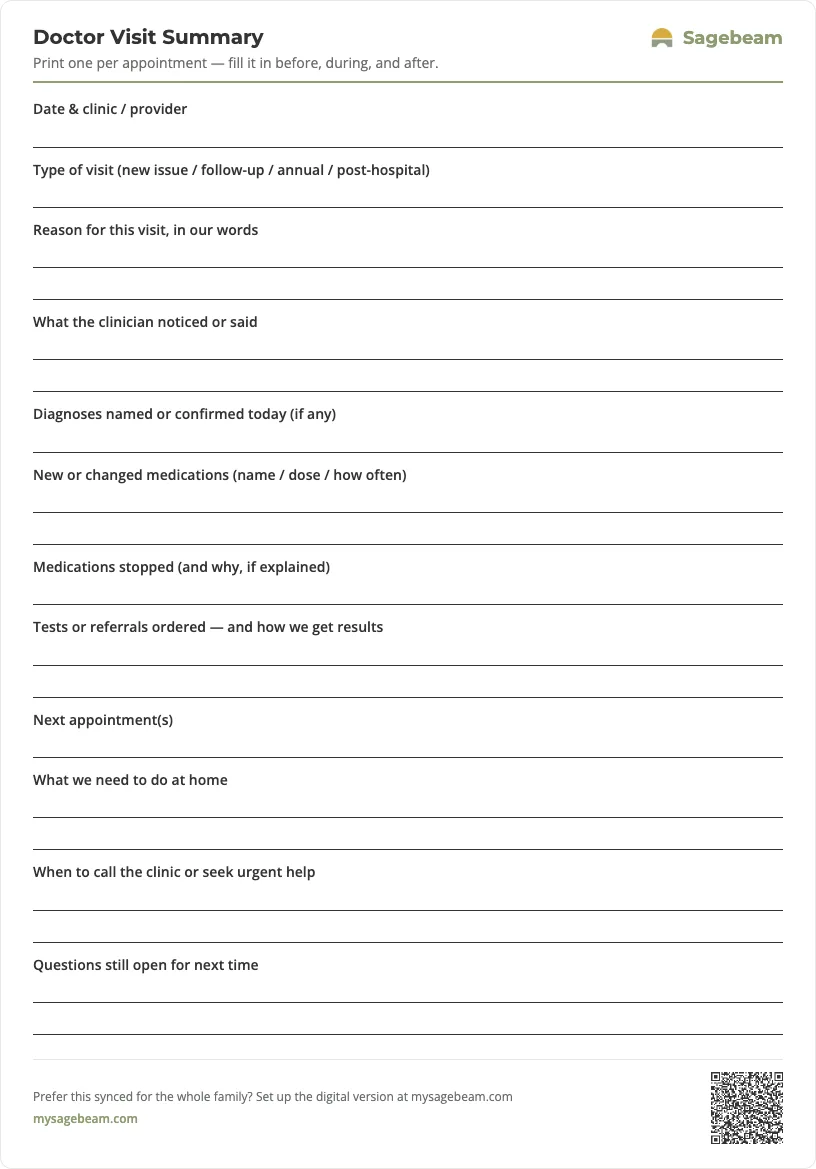
Print your doctor visit summary
A ready-to-use one-page sheet. Print it and fill it in by hand, or keep the same summary digitally so the whole family stays in sync.
 Sagebeam
- Daily schedule template for a person with dementia
- Dementia behavior and sundowning tracker template
- Dementia daily care log template for families
- Post-hospital symptom and red flag tracker template
You don't need more tabs. You need one place to run your parent's care.
By signing up, you agree to the Terms and Privacy Policy.